
After Halloween, it seems like a good time to cover dealing with lingering Zombies – in this case Projects.
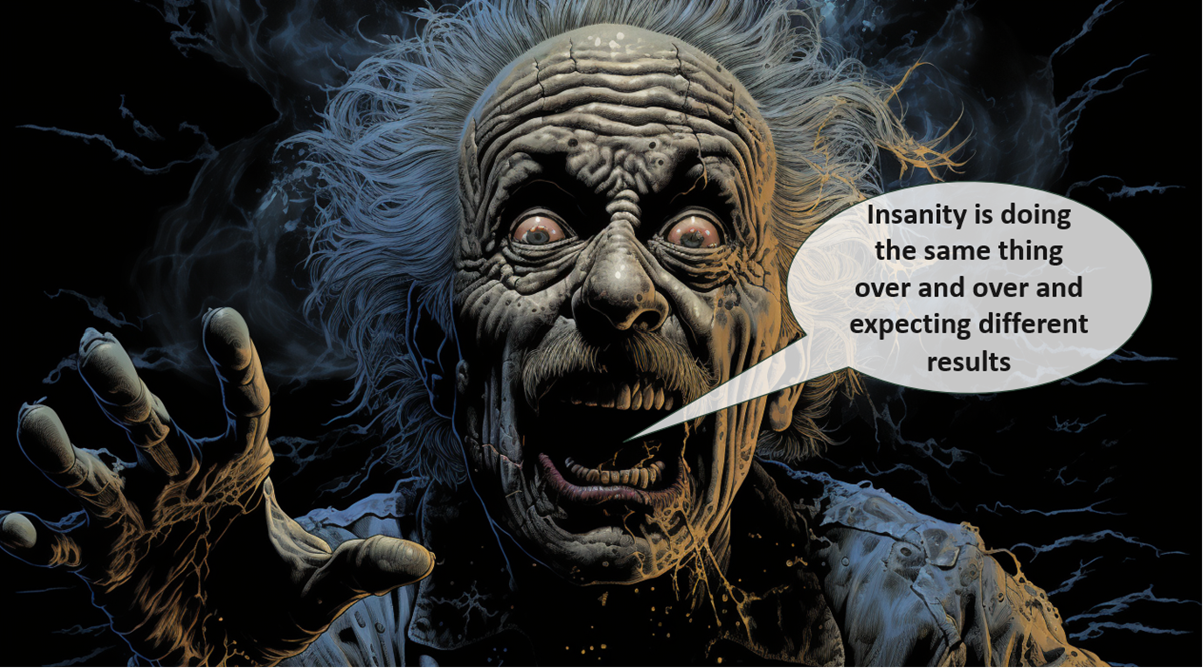
Insanity is doing the same thing over and over and expecting different results.
— Zombie Einstein · on the persistent funding of wayward projectsWhat is a Zombie Project?
A project that deserves to be put out of its misery yet continues to consume funding and resources. The reason for its warranted demise can be varied but mainly comes down to the Project's expected benefits being insufficient and/or misaligned with the organisation's goals. Yet, they persistently trudge on, reminiscent of the undying nature of zombies.
What is the impact of Zombie Projects?
The implications of maintaining Zombie Projects extend far beyond mere financial drain. As Businesses typically operate within limited resources and constraints, there is an opportunity cost of channelling efforts into futile projects at the expense of potentially profitable ones. Additionally, it places a heavy psychological toll on the employees as they invest time and energy into what is essentially an unsalvagable sinking ship. This dampens morale and induces stress, especially when they grapple with the looming inevitability of the Project's shortcomings coming to light when the proverbial zombie excrement hits the fan.
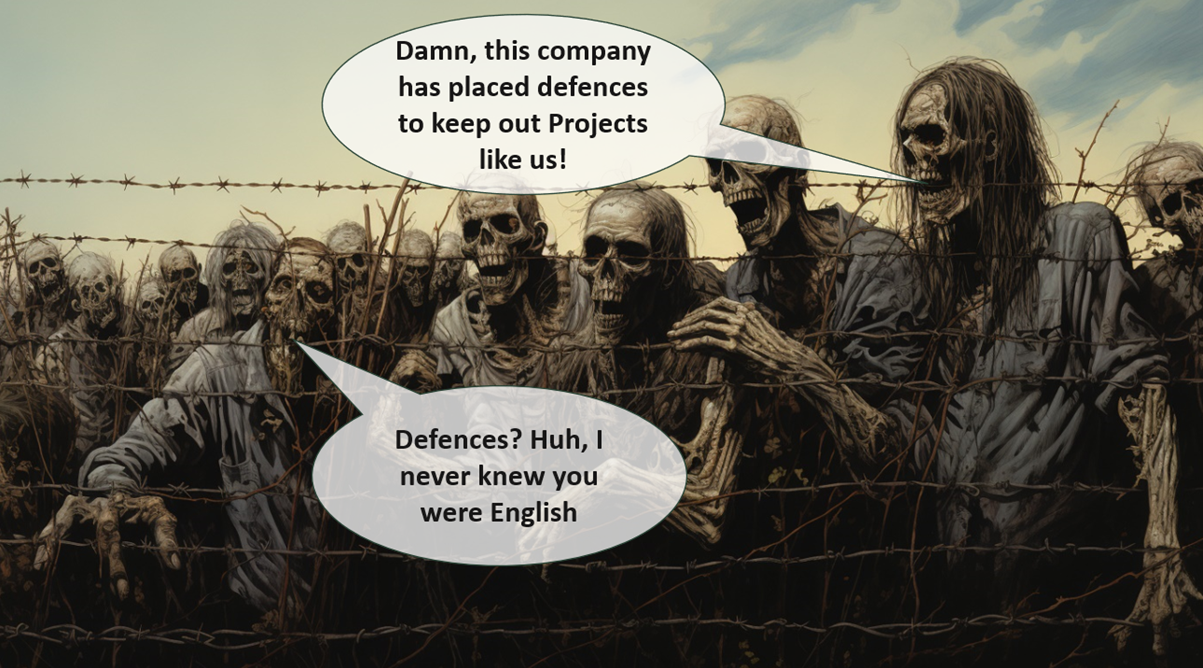
Even zombies recognise a well-defended organisation when they see one
Are Zombie Projects Common?
Based on personal observations and interactions within my professional network, Zombie Projects appear to be a widespread phenomenon and seem viral in organisations with stringent command and control structures and a prevalent fear of failure.
While I refrain from citing commonly quoted statistics and assertions regarding failing projects—mainly due to their questionable empirical validity—it's noteworthy that all change professionals I have encountered have witnessed or been part of a failing project that took far too long to be cancelled. In such scenarios, a significant portion of the project team, through lack of sleep and stress, may start to assume the cosmetic traits of the "Walking Dead."
The Reasons Zombie Projects Exist
Why continue to pour resources into an initiative that's evidently not on the path to success? Even "Zombie Einstein" would agree that persistently funding a wayward project without implementing any changes or strategies is a sheer exercise in futility—verging on insanity.
Yet, Zombie projects exist as they are resilient and do not die without a fight. While it seems logical to terminate stagnated or regressed Projects with a bullet to the head, it is not the knee-jerk reaction.
Instead, the modus operandi often involves massaging goals and objectives to paint a healthier picture of the Project's trajectory accompanied by a significant churn in project members and stakeholders. These new individuals arrive to replace burnt-out resources or as strategic replacements to usher in a fresh perspective or approach.
Making superficial changes to a Zombie Project is akin to chopping off a Zombies' arm. While it might momentarily hinder or distract the Zombie, it doesn't truly address the issue at hand (pun intended). The real solution requires a deeper introspection: revisiting and revalidating the Project's business case. Decision-makers must critically assess whether the Project can be revitalised and made viable or if it's more prudent to terminate it altogether.
However, Zombie Projects thrive because these essential evaluations are often overlooked. As a result, the fundamental problems persist, enabling the Zombie Project to trudge on undeterred.
Evaluating Project performance against its initial business case is often seen as a poison chalice. Large-scale programmes often have a delicate dance of politics and responsibility. Thus, stakeholders fully aware of the predicament may hesitate to voice concerns due to the fear of being the bearer of bad news.
In such environments, a real risk exists with openly communicating project failings. The age-old adage of "shooting the messenger" comes into play, especially when the individual raising concerns lacks the necessary political cover and influence within the organisation. Thus, the stakeholders wait for someone else to speak candidly, and the Zombie Project lives another day.
Terminating a large project after considerable resources have been expended is undoubtedly challenging. These past investments, known as sunk costs, loom large in decision-making even though they typically have no relevance in the Project's future viability. It is important to note that there are scenarios when sunk costs on investments need time to manifest tangible benefits, but aside from these cases, there needs to be an emotional purge relating to sunk costs. Decisions should be based on the forecasted benefits, where the past refers only to the salvageable value of products rather than the scale of historical investment.
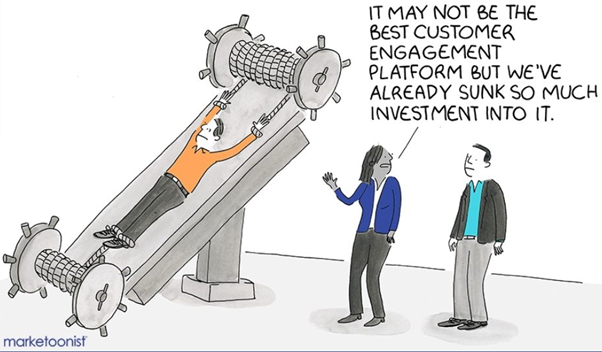
Source: Marketoonist · The sunk cost fallacy in action
To Fully Understand a Zombie Project — A Fictional Example
Business Case: In response to the soaring demand for rare earth minerals critical for advanced electronics and technologies, a large mining company named "Dino Mining Corporation" or "DMC" launched "DeepEarth." The Project aims to extract these minerals from untapped terrains, delving deeper into our planet's crust than any prior attempts.
DMC decided to adopt a high-stake approach to dominate the market. In a bid to outpace competitors, the company strategically decided to channel all its resources into the new venture. This involved scaling back and even halting operations in its profitable divisions. With this audacious move, DMC expects to be fully operational within three years and anticipates reaching the break-even point just one year later.
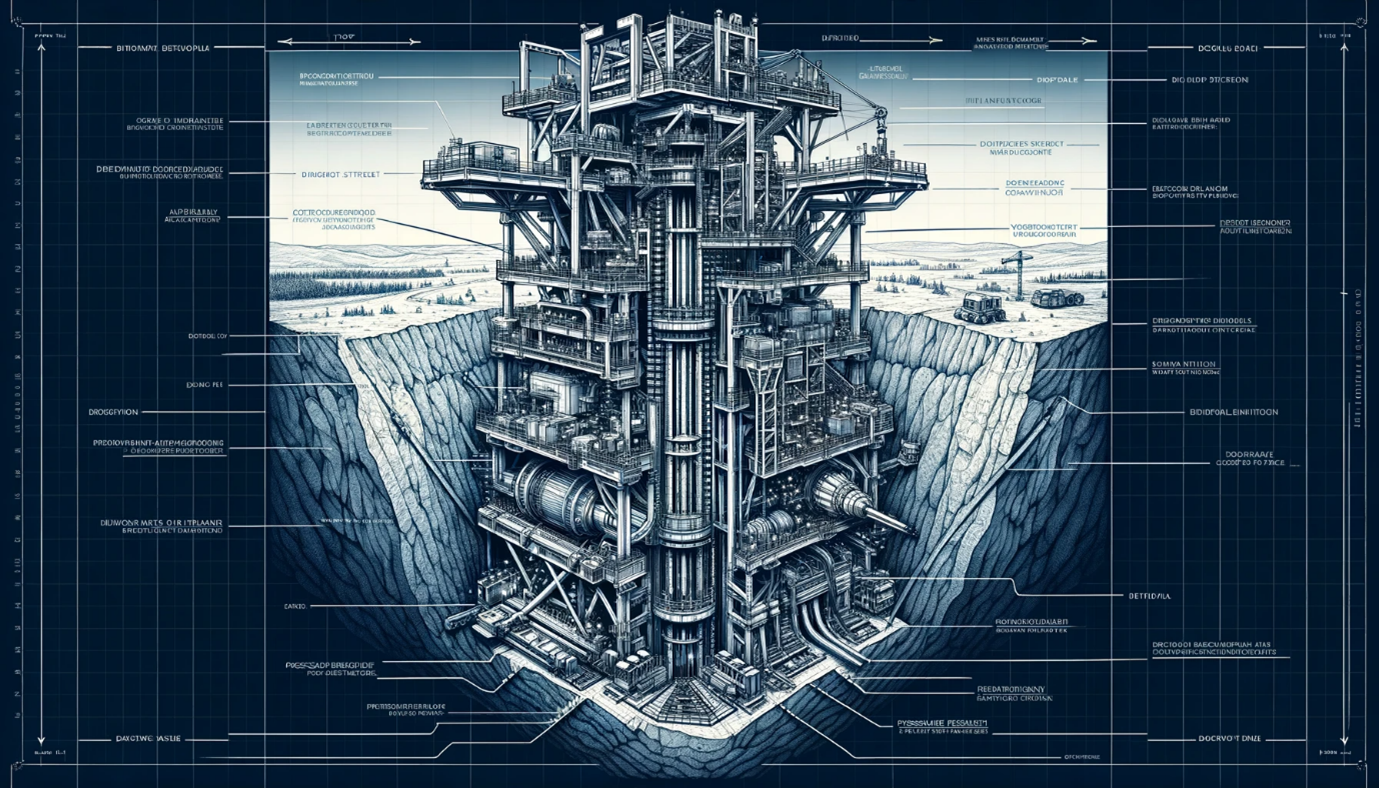
Technological Innovation: DMC invested heavily in developing cutting-edge drilling and extraction technologies, facilitating access to depths once considered uneconomical and impractical.
Environmental and Geopolitical Challenges: DeepEarth faced backlash from environmental groups due to concerns over ecological disruption. The extraction sites were also in politically sensitive regions, leading to regulatory and diplomatic challenges.
Financial Strains: DMC faced increasing costs related to deep earth extraction operations, environmental regulations, and geopolitical issues.
Disruptive Competition: "AstroAdapt", a new asteroid mining company, successfully demonstrated on its first mission it could extract large volumes of rare earth minerals at lower extraction costs with minimal impact on Earth's environment.
Investors immediately began to question the long-term profitability of DeepEarth. Still, DMC continued to invest heavily in DeepEarth, believing they could be profitable before AstroAdapt could scale up and be competitive.
Several years subsequent, bolstered by a stellar round of investments, AstroAdapt began delivering large volumes of "rare" Earth minerals, severely depressing the anticipated market prices for DMC's yield.
AstroAdapt enjoyed unparalleled success, rapidly ascending as the most prominent mining company in history. AstroAdapt offered to acquire DMC's DeepEarth facility to repurpose for their asteroid mining operations. Nonetheless, DMC's Board was sceptical of AstroAdapt's "PR Exercise" and declined the offer, holding onto the conviction that their research team could achieve a breakthrough, slashing costs by 90% to equalise the competitive landscape.
The following year, AstroAdapt surprised the world by announcing a new mineral not found on Earth with a resilience and price point to change the dynamics of the mining industry forever.
DMC remained fully committed to DeepEarth despite the shifting context. While mineral extraction had not commenced, there were advances towards achieving the cost objectives set two years earlier. Nonetheless, there was apprehension that these cost reductions stemmed from modifications in the forecasting model rather than any tangible developments.
DMC's leadership reaffirmed their commitment to the mining approach and decided to engage politicians for favourable subsidies and import constraints. Additionally, they channelled funds to discrete entities on platforms like Reddit and fringe forums, fostering conspiracy narratives surrounding the health risks of importing asteroid minerals and alleged government concealment regarding the vast mineral reserves deep within the Earth.
A year onward, the social media campaign yielded spectacular results, with a surging and formidable global distrust of asteroid mining and a widespread conviction in the value of untapped mineral reserves within the Earth. The executive team, bolstered by groupthink and confirmation bias, reinforced by global sentiment, grew increasingly confident of their strategic direction. In a fortunate turn of events, DMC mastered the methods to mine minerals at the predetermined costs, prompting the Board to approve the commencement of operations. It marked a celebratory milestone with bonuses distributed to all parties and the launch of operations broadcast live to audiences worldwide.
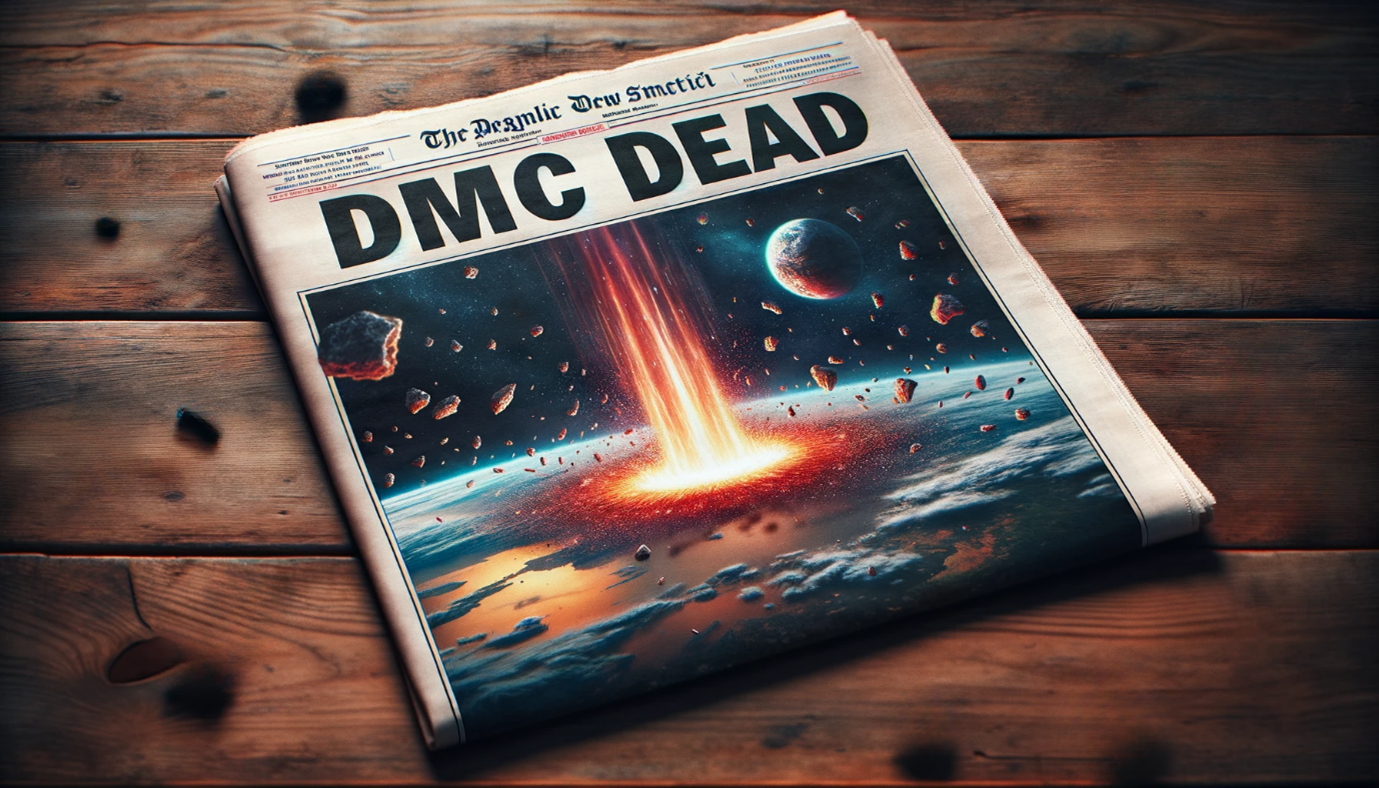
Within two weeks, DMC halted operations due to the inability to find buyers at viable prices. The Board swiftly stepped down, and administrative managers were summoned. The media did not overlook the irony of Dino Mining Corporation's downfall at the hands of an asteroid enterprise.
Prevention, Protection and Triage
The answer lies in formulating prevention, protection, and triage measures to combat the lurking Zombie menace.
In my opinion, prevention hinges on the Business Case, a prerequisite for every Project to justify its initial investment. This Business Case should feature clear KPIs determining the Project's viability at predetermined critical milestones. Implementing KPIs as thresholds, like a Contingency Change Budget, can reduce administration and decentralise decision-making. While these parameters are defined at the outset, they remain adaptable, with a revision mechanism in place. Flexibility is paramount, as external or internal disruption might alter a Project's perceived value.
Furthermore, not every Project should receive the utmost significance. Innovative companies initiate budget-conscious experimental proofs of concept. These companies have a "Fast-Failure" culture where failures are not chastised but perceived as a valuable learning exercise and investment.
In response to such challenges, an organisation can safeguard itself by periodically reviewing projects to monitor benefits and ensuring their alignment with the original Business Case and overarching organisational objectives. Emergency triage by trained professionals familiar with the KPIs who can recommend assistance or termination are the best weapon against the Zombie apocalypse.
When projects are discontinued, all is not lost. A successor Project can arise, strengthened by previous experiences and equipped with recalibrated KPIs and a refreshed Business Case.
Undoubtedly, as stated before, suggesting the termination of a project is a challenging endeavour. It demands clear, objective reasoning devoid of emotions. The business case should, therefore, be crafted to facilitate future financial and non-financial assessments.
The significance attributed to Project Closure rituals should also be tempered. These closures should be moderated and follow documented procedures, prioritising a psychologically safe environment. While they don't need to be celebratory, they should avoid blaming and scapegoats but instead focus on questions like What succeeded? What was unforeseen? Was it a stroke of good or bad fortune? Is there a discernible trend?
In summary, many factors must be considered when addressing the Zombie Project plague.
- 1 Can your company move towards a Fast Fail Culture?
- 2 How strong is Sunk Cost Fallacy and Confirmation Bias?
- 3 How adequate are the Business Cases and are they regularly reviewed?
- 4 Do you utilise influential external and impartial resources?
- 5 How effective is your company in monitoring disruptive technology and competition?
Be merciful to your Zombie Projects. It is better to terminate them than leave them in a state of neglect, slowly starved of resources until they expire (Do Zombies Breathe?)
I wish you the best of luck in protecting your organisation from Zombies!